
UPDATE – 100% arrived in Antigua on 12th December.
The new owners of a Silent Yachts 62 Tri-Deck solar electric catamaran – which they named ‘100%‘ – are sailing their new purchase across the Atlantic and you can track her progress, monitor the solar system and ask questions of the crew as they make the 3,200 nautical mile journey from Gibraltar to Antiqua.
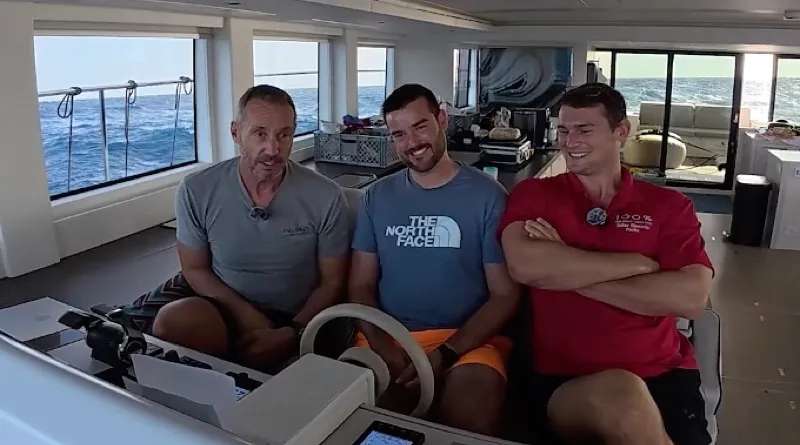
Owners Rebecca and Jay are joined by Steve Bell, Vice-Chairman of Silent-Yachts, and crew members Will and Mike. The team left Gibraltar on November 14 and expect to land in Antigua around December 11 or 12. We caught up with Captain Bell on Sunday, November 30 to find out more about the yacht and the journey.
Following in the path of history
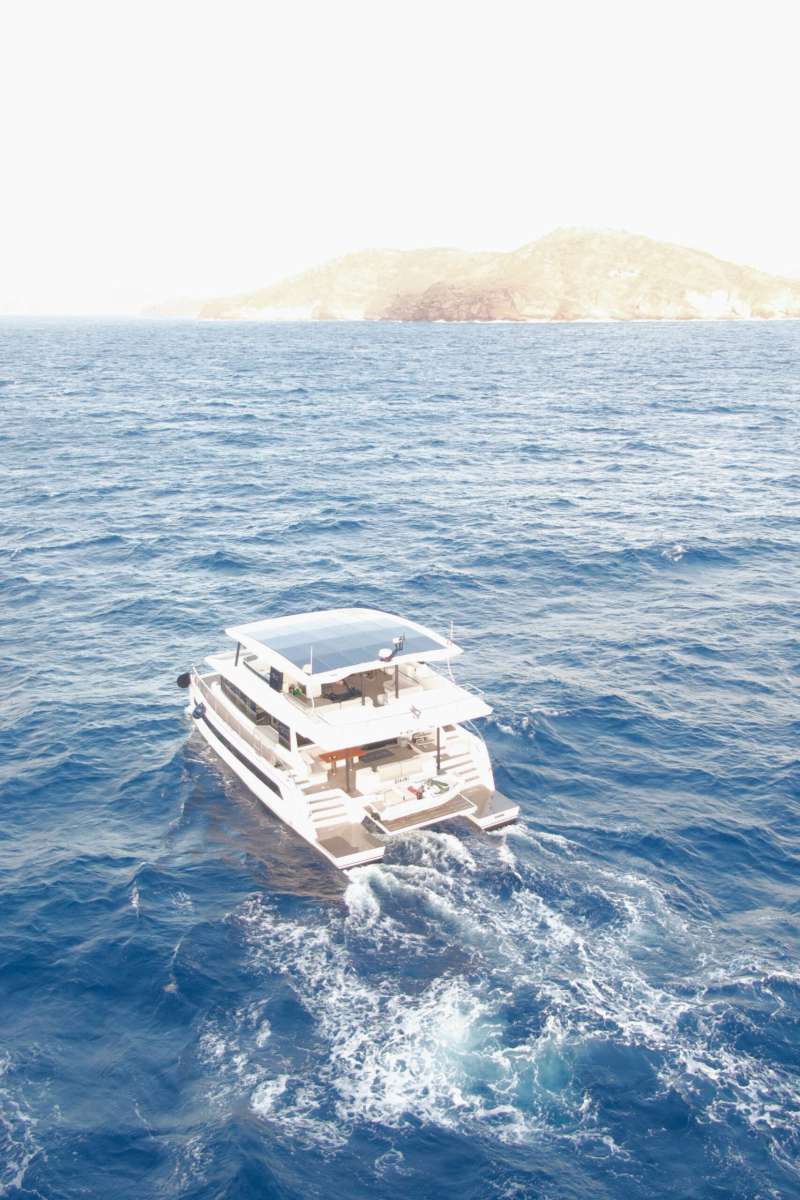
First, the yacht. 100% is a Silent 62 Three-Deck, the latest version of the Silent 64 (two deck) which won the German Design Award, Best of Boats, Multihull of the Year and Gustave Trouvé Electric Boat Awards in 2021. It was an SY64 that was first ever solar powered production yacht to cross the Atlantic almost 8 years ago, in January of 2018.
Read: Plugboats sea trial of the Silent 60
Electric motors, batteries, solar panels and every technology on board have made big advances since that time, and the SY62 is is equipped with all the latest iterations. Two 164 kW (225 hp) electric drives are backed with 354 kiloWatt hours of battery storage and solar arrays spread across the roofs of the second and third decks with a total generating capacity of 16.8 kW peak.
The 100% is a four cabin version, the most popular layout, with the master and VIP cabins in one catamaran hull and two smaller twin or double/combination cabins in the other. The main deck is a spacious open area that spans the full width of the cat with panoramic window views. It holds the main helm along with a large clean salon area and full galley that is ‘stocked to the gunnels’ with food for the transatlantic crossing.
The third deck has a fly helm and large lounge and entertaining area that was one of the key reasons the couple purchased the boat. “Being able to come up here at anchor or a mooring is just fantastic,” says Jay “and when you’re underway, the view that you have, being to be able to look around and see everything 360º, it’s just amazing.”
The yacht was delivered to Rebecca and Jay this past spring at the Silent Yachts boatyard in Italy and they put that third deck lounge to good use cruising around the Mediterranean all summer.
They had always imagined taking it on a long journey, though, and getting the 100% from Europe to their home base in North America offered them the perfect opportunity to see how she fared on the open ocean. They had become good friends with Steve during the course of the building of the yacht, and so when they suggested the unconventional method of delivery he eagerly jumped on board to captain.
The technology of Silent Yachts was another big purchase driver for Jay, and the trip is a way to put every system to the test, everything from energy production to speed, battery use and silent navigation. Sailing from Gibraltar to Antigua also allows the crew to monitor real efficiency over thousands of nautical miles and see up close how all the aspects of the 62 respond over an extended period.
Follow everything on silentatlantic.com
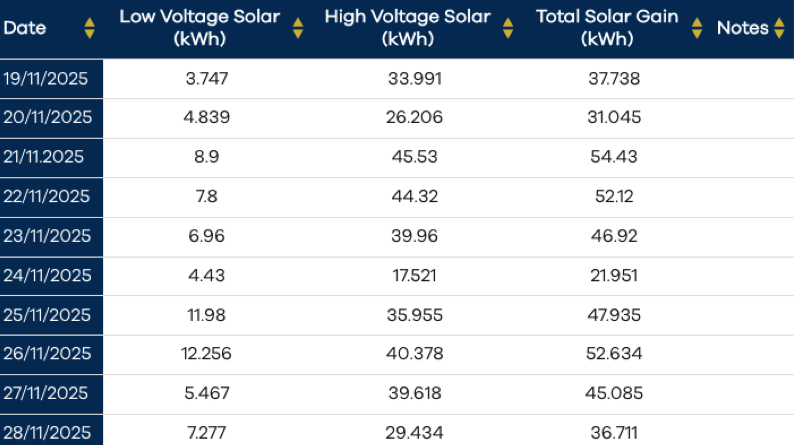
Transparency is also a key part of the project. Silent Yachts has set up a dedicated website – silentatlantic.com – where anyone can track the vessels’s progress on the ‘Itinerary’ link and see the real data behind the voyage on the Technology and Solar Gain link. The crew is also sharing a video blog about Life On Board and you can ask questions of Steve and the crew on the Q&A page. The purpose is simple: gather data, share them openly and show what long-range electric navigation can achieve today.
When we talked with Steve and crew the 100% was about 250 miles west of Cape Verde, just off the coast of Africa, with 1800 miles to go to Antigua. They were cruising at an average of about 6 knots, with ‘average’ being the operative word.
“We’ve got quite a big swell” said Steve, “so we end up going down the swell at something like eight knots, and up the swell, at four knots. So it’s changing.”
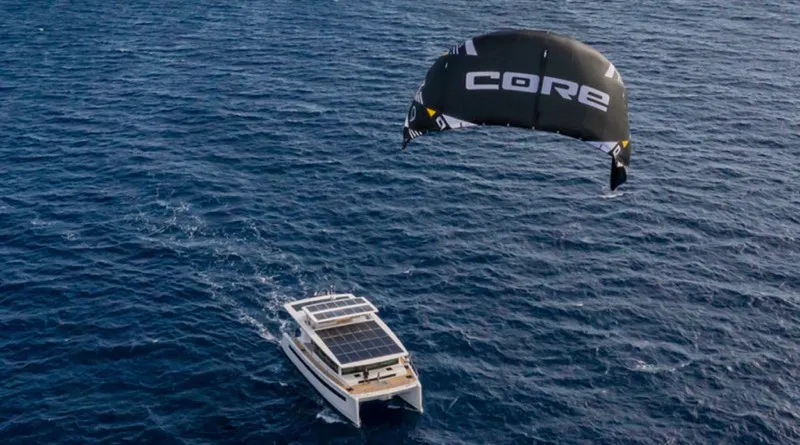
He mentioned that their route is designed to pick up the northern equatorial currents and the trade winds, but they had not reached them yet. Instead, they had a high pressure system above them, which was forcing some winds across their beam, rather than from behind. Unfortunately, that made it difficult to use the fully automatic towing kite designed to allow the yacht to make use of the wind without shading the solar panels.
Without the kite, the boat needs to run entirely under motor power, which requires about 30 kiloWatts of power to maintain a 6 knots speed. Without the wind, and with the positioning of the sun at this time of year, that makes it necessary to run the 134 kiloWatt diesel generator for some of the day.
As Steve explained: “We’ve got 17 kilowatts of solar, peak, but you can see from our charts on the website, I think the maximum we’ve seen in 24 hours is 56 kilowatt hours. With the motor and the hotel load – there’s no air conditioning on at the moment – that leaves us with a negative of about 20 kiloWatts from what we can get out of the panels. So at the moment, we’re currently running the generator about four to five hours in a 24 hour period.”
The Silent Atlantic initiative has taken some flack on social media for not being 100% fossil fuel free, but that was never the ultimate goal of the journey, and the line of Silent 60s was never designed for going across oceans.
They are designed for coastal cruising, like – Rebecca and Jay enjoyed in the Mediterranean – or island hopping in somewhere like the Caribbean, where the yacht is headed. In those conditions there are plenty of opportunities to anchor and let the sun recharge the battery, or move along at a slow pace, so the solar panel generation is balanced with the energy required for propulsion. “We could slow this down to four knots and virtually be self sustainable during the day,” says Steve “but the owners and and I certainly don’t want to be at sea on Christmas Day!”
There is also the matter of actual sunshine available. “It’s winter, the sun is close to the 23rd southern parallel, not anywhere near above us, so you’ve only got a maximum of 10 hours of sunshine.”
“So it’s limiting the solar but if you think about this, will be the most economical crossing of any motor driven 60 foot catamaran across the Atlantic. We’ll probably use 3,000 litres of fuel, which is about 800 US gallons. But a similar size yacht running all diesel would be 8, 9 or 10,000 litres (2,600 gallons), so we’re one third or less.”
As mentioned earlier, one of the key parts of the project is transparency. By openly sharing all the data not just with the engineers and designers of Silent Yachts, but with everyone interested in solar electric sailing, the goal is to make every aspect of the experience continually better and more efficient.
Click below to follow the 100%, see the data and ask any questions that come to mind.
Full article HERE
@silentyachts